Types of Suits Explained: Styles, Fits, Lapels and Collar Options for Men and Women
March 3, 2026
Britain has one of the great tailoring traditions in the world, and yet the sheer range of options available, suit…
read more
Semi-formal is one of the dress codes that sounds self-explanatory until the invitation arrives and the questions begin. Not quite formal, not quite smart casual, it occupies the middle ground of the British dressing calendar with more frequency and less clarity than most other codes. Weddings, corporate dinners, evening receptions, award ceremonies, and client events all commonly call for semi-formal attire, and what that requires can vary considerably depending on the venue, the time of day, and the nature of the occasion.
The principles, once understood, are straightforward. Semi-formal dressing asks for polish, structure, and occasion-appropriate elegance without requiring the full formality of black tie. It rewards tailoring, quality fabric, and deliberate styling. It leaves room for personality and modern interpretation without losing the composed authority that separates it from smart casual. In Glasgow and across the wider UK, it is a dress code that appears often and rewards those who understand it.
This guide explains what semi-formal dress code means in practice for men and women, how it relates to the codes on either side of it, and how to dress for it with confidence across the range of occasions it typically covers.
A semi-formal dress code calls for a polished and occasion-ready appearance that sits between the relative freedom of smart casual and the strict requirements of formal or black-tie dressing. It is more refined and structured than smart casual but allows more flexibility in silhouette, fabric, and styling than a full formal dress code.
The clearest way to understand semi-formal is through the concept of occasion-appropriate dressing. The outfit should look as though it belongs in the room and has been chosen with the event in mind, not assembled from everyday workwear or relaxed weekend clothing. Tailored structure, premium fabrics, clean silhouettes, and carefully chosen accessories are what define a genuinely semi-formal look. The impression should be composed and considered, not ceremonial.
In the UK, the semi-formal dress code often depends significantly on context: the venue, the time of day, the season, and the nature of the event can all shift where the semi-formal standard sits. A corporate awards evening calls for something different from a daytime garden wedding or an evening social reception, even though all three may describe their dress code as semi-formal. Understanding those distinctions is as useful as understanding the code itself. For those looking to build a wardrobe that handles this range with ease, Suited & Booted’s men’s casual tailoring service is a strong starting point.
For men, semi-formal dressing is built around tailored suits, refined separates, crisp shirts, polished shoes, and considered accessories. A tuxedo is not required and would often be too formal, but the overall look should be clearly sharp, intentional, and well put together. Semi-formal is not an excuse for a business suit that has been worn all week, and it is not an invitation to treat the occasion as smart casual.
For evening events, a darker suit is almost always the stronger choice. Navy, charcoal, and deep tones carry the weight of the occasion in a way that lighter colours cannot, and a well-cut dark suit with a crisp dress shirt, polished shoes, and a considered tie or open collar is one of the most reliable semi-formal looks available. For daytime events such as weddings or professional occasions, lighter cloths, softer tones, and a slightly more relaxed approach to the shirt and tie combination can all work well while still reading as clearly semi-formal.
Styling ideas for men include a well-fitted two-piece suit with a white dress shirt and a silk tie, a tailored blazer worn with smart trousers and an open-collar shirt in a premium fabric, or a linen-blend two-piece in a refined neutral for a daytime summer occasion. The connecting thread is always fit, fabric, and footwear: when these three elements are right, the look carries itself.
Women have considerably more interpretive freedom within the semi-formal dress code, but the underlying principle remains the same: the outfit should balance elegance and structure, avoiding both the informality of everyday casualwear and the strict formality of full evening or black-tie dress.
Midi dresses in refined fabrics, tailored co-ords, elegant wide-leg trouser suits, structured blazers worn with polished separates, and refined blouses with formal skirts or tailored trousers can all sit comfortably within a semi-formal setting. The look should feel modern and deliberately dressed, with the kind of considered finish that makes it clear the outfit was chosen for the occasion.
For evening events, richer fabrics, deeper tones, and more considered accessories move the look toward the upper end of the semi-formal register. For daytime occasions, lighter cloth, softer colours, and a more relaxed silhouette can work equally well. What matters most is that the overall impression is clearly elegant and intentional, free of the casualness of everyday dressing and the formality of full eveningwear. Suited & Booted’s bespoke womenswear tailoring is designed precisely for occasions like these, where the right fit and fabric make all the difference.
Understanding where semi-formal sits in relation to the dress codes on either side of it is the most efficient way to navigate it confidently. The distinctions are not difficult once the principles are clear.
Semi-formal occupies the middle ground between formal and smart casual. It retains the polish and occasion-appropriate structure of formalwear while allowing more personality, softer fabrics, and more flexible silhouettes. Where formal dressing tends toward the traditional and elevated, semi-formal can carry a more modern and personal interpretation without losing its composure.
Context is always the deciding factor. A semi-formal corporate dinner, a semi-formal wedding, and a semi-formal evening function may each require a slightly different interpretation of the same dress code. The venue, the time of day, the company, and the level of formality implied by the occasion should all inform the final decision. Suited & Booted’s tailoring services for men are built around exactly this kind of nuanced, occasion-led approach to dressing.
Formal dressing is generally more traditional, structured, and elevated than semi-formal. For men, formal occasions may require a tuxedo, dinner jacket, or a sharply tailored dark suit with all the appropriate formality of shirt, tie, and shoes. For women, formal occasions call for evening gowns, polished suiting, or highly refined separates with a clear sense of occasion dressing.
Semi-formal can still include a suit for men or an elegant dress for women, but with less rigidity and more room for individual styling. A suit worn for a semi-formal event does not need to carry the same weight of formality as one worn to a black-tie dinner, and a woman’s dress at a semi-formal wedding does not need the full-length, maximum-formality register of a gala gown. The key is that semi-formal should never look underdressed. Even though it is less demanding than formalwear, the outcome should be clearly polished and occasion-appropriate.
Smart casual is a noticeably more relaxed dress code than semi-formal. Where smart casual introduces polish and structure into an otherwise relaxed outfit, semi-formal asks for a clearer level of occasion-readiness from the start. The starting point is different.
Jeans, trainers, casual knitwear, and relaxed styling, all of which can work well for smart casual, are generally not appropriate for semi-formal occasions. The tailoring, footwear, and overall finish of a semi-formal outfit should feel event-ready, composed, and clearly above the register of smart casual, even when the occasion in question is not particularly grand. A clean, polished look that could comfortably hold its own in a well-dressed room is the right benchmark.
Semi-formal dressing in Glasgow and across the UK needs to account for the practical as well as the aesthetic. Venue, weather, season, and the nature of the occasion all shape what a well-judged semi-formal outfit looks and feels like in practice. In a country where the weather can change significantly between morning and evening, and where prestigious events are often held in older buildings that present their own practical considerations, the most successful semi-formal looks are those that have been thought through from the beginning, not assembled in a hurry.
A daytime occasion will typically allow lighter cloths, softer tones, and a slightly more relaxed approach to structure. An evening occasion usually asks for more: darker tones, sharper tailoring, and a higher level of finish. A professional occasion may need to communicate authority and credibility as well as elegance. A social occasion may allow more personality and expression within the same basic framework. Considering whether the event is daytime or evening, professional or social, traditional or modern is the most efficient way to calibrate the right interpretation.
In professional and corporate settings, semi-formal dressing should communicate authority, confidence, and polish without appearing ceremonial or overdressed. The aim is to look sharp and credible while remaining clearly at ease in the room.
For men, a tailored two-piece suit in a refined cloth, worn with a dress shirt and smart shoes, is the most reliable starting point. A tie is not always required, but the overall look should be clearly intentional. Dark navy, charcoal, and deep seasonal tones carry the right weight for business dinners, awards evenings, client events, networking functions, and corporate receptions.
For women, tailored dresses, elegant suits, polished blouses with structured separates, and refined footwear all work well in professional semi-formal settings. The outfit should feel professional and modern, avoiding the informality of everyday office dressing and the severity of full formalwear. Structured fabrics, clean silhouettes, and considered accessories are the elements that make the look read as semi-formal rather than simply well-dressed.
Weddings and evening events give slightly more room for personality within the semi-formal framework, but the expectation of a polished and occasion-appropriate appearance remains firmly in place.
For men at a semi-formal wedding or evening function, a well-cut suit in a considered cloth, a sharp shirt, and polished shoes form the foundation. Tie choice is often contextual: a formal tie for a more traditional occasion, an open collar for something more contemporary. The details, pocket square, cufflinks, footwear, should all be chosen with the occasion in mind rather than as an afterthought.
For women, elegant dresses, tailored jumpsuits, refined co-ords, and formal separates all sit comfortably within a semi-formal social setting. The silhouette, fabric, and accessories should feel sophisticated and occasion-appropriate without crossing into full evening or black-tie formality. For a daytime wedding, lighter cloths and softer tones tend to work well; for an evening function, richer fabrics and deeper colours move the look toward the upper end of the semi-formal register.
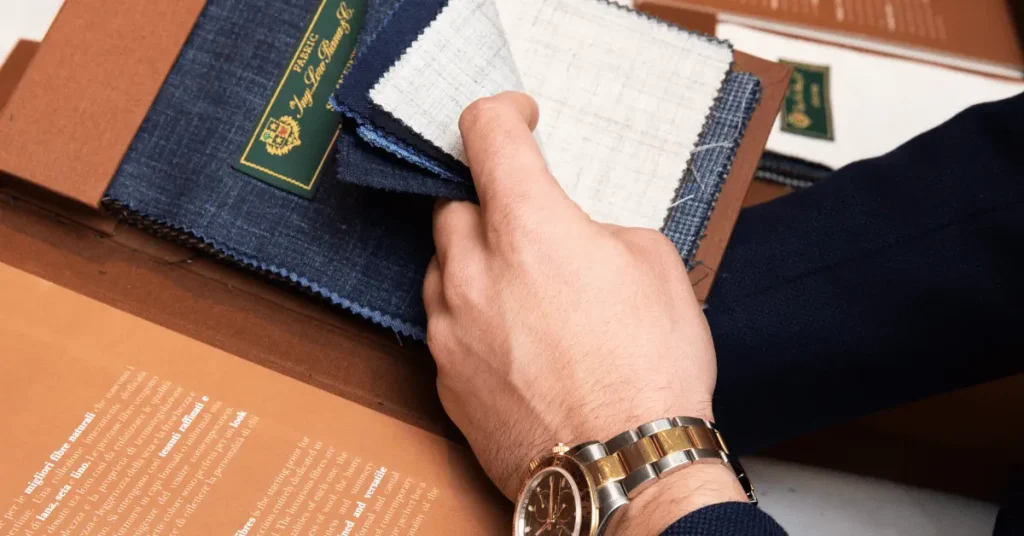
The quality of a semi-formal look depends significantly on the same elements that define any well-considered outfit: fabric, fit, and finishing. In a dress code that offers more flexibility than formal, these elements become more rather than less important, because there is less structure in the code itself to carry the outfit. The tailoring, the cloth, and the details are what make the difference between a look that reads as genuinely semi-formal and one that falls somewhere between dressed up and smartened up.
In Glasgow and across the UK, the season and the venue should always inform the fabric choice. The climate is genuinely variable, and a carefully chosen cloth that works across a full day, including an outdoor arrival and a heated interior, will serve the wearer considerably better than one chosen purely on appearance.
For men, the most reliable semi-formal fabrics are those that hold a clean line while remaining comfortable across the full occasion. Lightweight wool and mid-weight wool suiting are strong year-round options. Flannel brings depth and character to autumn and winter events. Brushed cotton and refined cotton shirts work well for daytime occasions in warmer months. Merino knitwear can serve as an elegant alternative to a more formal shirt and tie combination at the right kind of event.
The finishing details of a men’s semi-formal outfit carry more weight than they are often given credit for. Footwear is the clearest signal of the level of formality the wearer has aimed for: Oxford shoes, Derby shoes, refined suede shoes, and well-chosen loafers all work well, while casual trainers or overly relaxed styles will bring the look down regardless of the quality of the rest of the outfit. A pocket square, a considered tie, quality cufflinks, and a well-chosen outerwear piece all contribute to the overall impression. The aim is deliberate and refined, not heavily decorated.
For women, the strongest semi-formal fabrics combine structure with refinement. Structured suiting cloths, silk blouses, crepe dresses, wool blends, and tailored jackets in seasonally appropriate textures all work well depending on the event and the time of year. Knitwear in merino or fine wool can be a sophisticated layer for daytime occasions, while silk and crepe carry the weight of the occasion naturally for evening events.
The finishing details matter as much for women as for men. Footwear should be clearly appropriate for a polished occasion: refined heels, elegant flats, and loafers in quality materials all work well, while overly casual shoes or sandals are generally not at home in a semi-formal setting. Bags, jewellery, and outerwear should support the outfit rather than compete with it. Suited & Booted’s approach to bespoke womenswear ensures every element, from cloth to cut to finish, is chosen with the occasion in mind.
The most common error with semi-formal dressing is defaulting too far toward casual. Denim, trainers, sportswear-inspired pieces, and overly relaxed knitwear are all common choices that fall below the semi-formal standard, however well they work in a smart casual context. The event has asked for a certain level of dressing, and meeting that level is both a practical requirement and a matter of respect for the occasion and the host.
Confusing semi-formal with black tie is the opposite error, and while it is less common, it is worth noting. A tuxedo or full evening gown at a semi-formal occasion can make the wearer look as misjudged as someone who has underdressed. Unless the invitation suggests an elevated or black-tie register, a well-tailored suit or an elegant dress in the right fabric will always be the more correct choice.
Dressing without reference to the venue, season, and time of day is another frequent mistake. A beautifully chosen outfit that is completely impractical for the setting, too light for a cold November evening, too warm for an outdoor summer wedding, too formal for a relaxed social occasion, will not serve the wearer well regardless of how good it looks on paper. The best semi-formal outfits are both elegant and appropriate.
Poor fit, inappropriate footwear, and accessories that feel too casual or too loud are the final categories of common error. Semi-formal dressing requires a certain level of care in the details. A jacket that does not sit correctly, trousers that are the wrong length, or shoes that belong in a different setting will undermine the rest of the outfit. See how these principles come together across different occasions in the Suited & Booted lookbook.
A semi-formal wardrobe built with purpose should be able to cover corporate events, weddings, evening receptions, client occasions, and the range of professional and social settings that make up an active working life in Glasgow and across the UK. The pieces should feel versatile, polished, and genuinely well-made: garments chosen for longevity, fit, and the ability to move between occasions without looking out of place.
Suited & Booted brings a bespoke approach to semi-formal attire for both men and women. For men, that may mean a tailored suit, refined separates, or a tuxedo where the occasion demands it, cut from premium cloth and fitted precisely to the individual. For women, it may mean tailored suiting, elegant dresses, formal separates, or modern womenswear designed with the full range of professional and social occasions in mind.
The value of expert tailoring in a semi-formal wardrobe is in the fit, the fabric, and the confidence that comes from knowing the outfit is right. Semi-formal dressing leaves enough flexibility to express genuine personal style; having the foundation pieces made to measure means that flexibility is always in the wearer’s favour.
Book an appointment with Suited & Booted Glasgow
Semi-formal dress code is a polished and occasion-appropriate style of dressing that sits between smart casual and full formalwear. It combines tailored structure, refined fabrics, and a composed overall finish, and is commonly seen at weddings, corporate events, evening functions, and professional social occasions.
Formal dress code is generally more structured, traditional, and elevated, often requiring a tuxedo for evening occasions or sharply tailored suiting for corporate events. Semi-formal allows slightly more flexibility in silhouette, fabric, and styling while still maintaining a clearly polished and occasion-ready appearance.
No. Semi-formal is more polished and structured than smart casual. Smart casual can include relaxed pieces elevated with a sharper layer or better footwear, while semi-formal asks for a consistently higher level of finish throughout the outfit. Jeans, casual trainers, and relaxed knitwear, which can work well in smart casual settings, are generally not appropriate for semi-formal occasions.
Semi-formal attire for men usually includes a tailored suit, a crisp dress shirt, polished shoes, and considered accessories. For evening occasions, a darker suit in a refined cloth is generally the strongest choice. For daytime events, lighter tones and a more relaxed approach to shirt and tie choice can work well within the same basic framework.
A suit is usually the safest and most appropriate option for semi-formal men’s attire, although a well-chosen tailored blazer with smart trousers can also work when styled with a crisp shirt, polished shoes, and a considered overall finish. The key is that the look feels clearly tailored and occasion-appropriate rather than assembled from casual staples.
Oxford shoes, Derby shoes, loafers, and refined suede shoes are all appropriate choices for semi-formal attire, depending on the occasion, the suit, and the overall tone of the event. The footwear should complement the tailoring and communicate the same level of care. Casual trainers, overly relaxed styles, or shoes that belong to a daytime or casual context are generally not appropriate.
Semi-formal attire for women can include elegant dresses, tailored suits, jumpsuits, polished separates, or refined co-ords, styled with sophisticated footwear and understated accessories. The look should feel occasion-appropriate and clearly elevated, balancing elegance with structure without crossing into the formality of full eveningwear.
Women dressing semi-formally can choose from elegant midi or full-length dresses, tailored trouser suits, jumpsuits in refined fabrics, polished co-ords, or structured separates. The most important factors are the quality of the fabric, the precision of the fit, and the overall impression of the outfit: composed, polished, and clearly chosen with the occasion in mind.
March 3, 2026
Britain has one of the great tailoring traditions in the world, and yet the sheer range of options available, suit…
read moreSeptember 24, 2025
When it comes to world-renowned bespoke tailoring, Savile Row in London stands at the pinnacle of sophistication and craftsmanship. Often…
read more